Sony
For this terms contextual studies we are going to be writing about the possibilities and limitations presented by different gaming platforms, in the market and how they are distributed.
We will be looking at how to understand the relationship between the hardware and software design of game-related computing systems and the creative work produced by the companies.
In this case we are lucky to be talking to Sony, one the top franchises and companies in the world.
The History of Sony
 In late 1945, after the end of World War II, Masaru Ibuka started a radio repair shop in a bomb-damaged department store Shirokiya building in Nihonbashi of Tokyo. The next year, he was joined by his colleague, Akio Morita, and they founded a company called Tokyo Tsushin Kogyo K.K. (Tokyo Telecommunications Engineering Corporation). The company built Japan's first tape recorder, called the Type-G. In the early 1950s, Ibuka travelled in the United States and heard about Bell Labs' invention of the transistor. He convinced Bell to license the transistor technology to his Japanese company. While most American companies were researching the transistor for its military applications, Ibuka and Morita looked to apply it to communications. Although the American companies Regency Electronics and Texas Instruments built the first transistor radio as joint venture, it was Ibuka's company that made them commercially successful for the first time.
 In August 1955, Tokyo Tsushin Kogyo released the Sony MK-55, Japan's first commercially produced transistor radio. They followed up in December of the same year by releasing the Sony TR-72, a product that won favor both within Japan and in export markets, including Canada, Australia, the Netherlands and Germany. Featuring six transistors, push-pull output and greatly improved sound quality, the TR-72 continued to be a popular seller into the early sixties.
University of Arizona professor Michael Brian Schiffer, PhD, says, "Sony was not first, but its transistor radio was the most successful. The TR-63 of 1957 cracked open the U.S. market and launched the new industry of consumer microelectronics." By the mid 1950s, American teens had begun buying portable transistor radios in huge numbers, helping to propel the fledgling industry from an estimated 100,000 units in 1955 to 5,000,000 units by the end of 1968.
http://en.wikipedia.org/wiki/Sony#History
Origin of the Name
 When Tokyo Tsushin Kogyo was looking for a Romanized name to use to market themselves, they strongly considered using their initials, TTK. The primary reason they did not is that the railway company Tokyo Kyuko was known as TKK. The company occasionally used the acronym "Totsuko" in Japan, but during his visit to the United States, Morita discovered that Americans had trouble pronouncing that name. Another early name that was tried out for a while was "Tokyo Teletech" until Akio Morita discovered that there was an American company already using Teletech as a brand name.
At the time of the change, it was extremely unusual for a Japanese company to use Roman letters to spell its name instead of writing it in kanji. The move was not without opposition: TTK's principal bank at the time, Mitsui, had strong feelings about the name. They pushed for a name such as Sony Electronic Industries, or Sony Teletech. Akio Morita was firm, however, as he did not want the company name tied to any particular industry. Eventually, both Ibuka and Mitsui Bank's chairman gave their approval.
The PlayStation

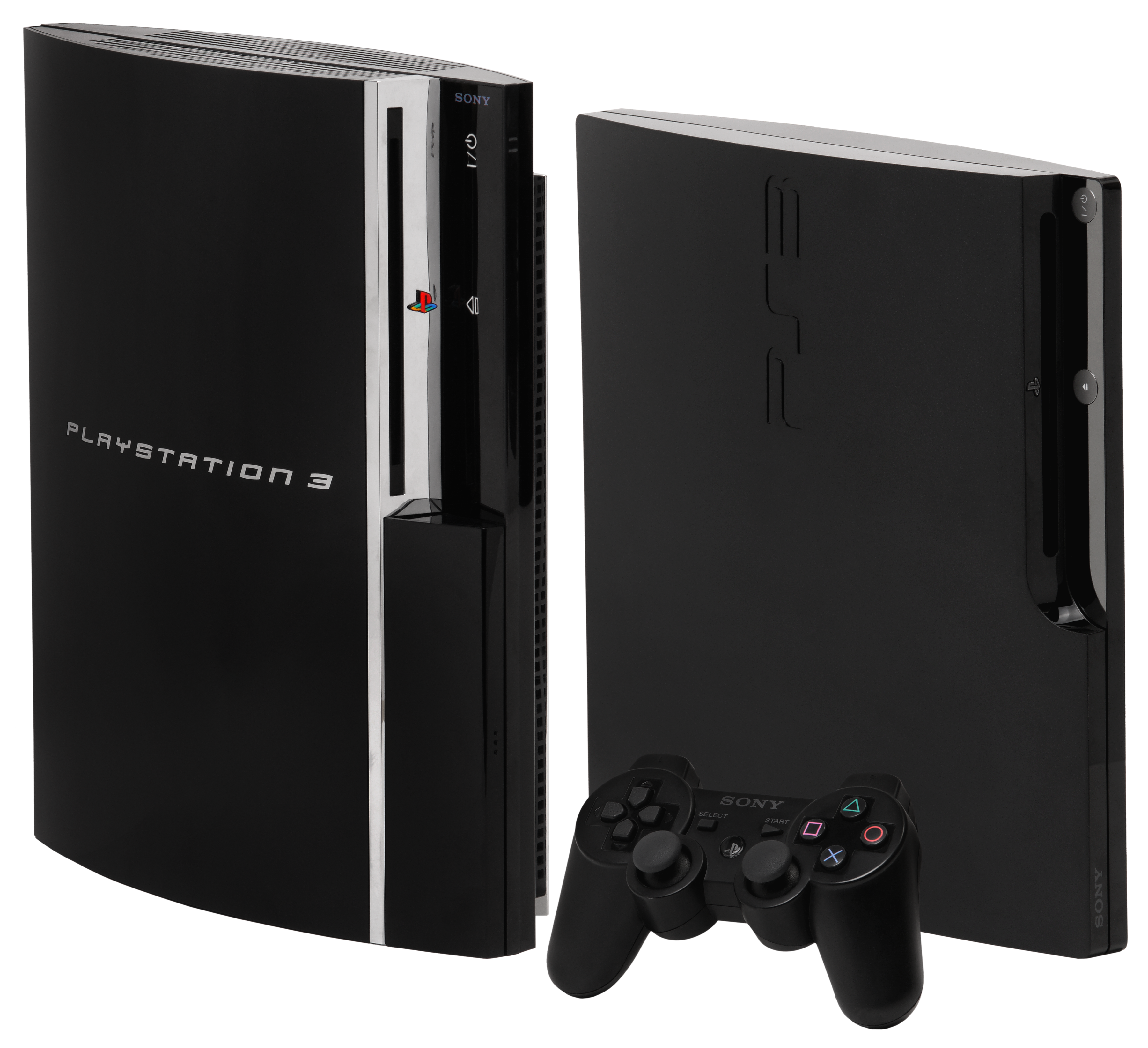
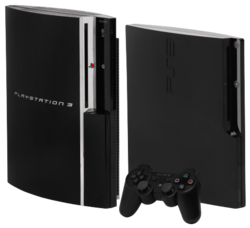
 Sony released the PlayStation 3, a high-definition console, in 2006. It later introduced the PlayStation Move, an accessory that allows players to control video games using motion controllers. Sony announced that on 1 April 2010 it was electronically removing Linux functionality from the first generation PS3. A class action has been taken out in California challenging the legality of "the disablement of valuable functionality originally
walls. As of early January 2006, Sony had no plans to keep or withdraw them.
In November 2006, a marketing company employed by Sony created a website entitled "All I want for Xmas is a PSP", designed to promote the PSP through viral marketing. The site contained a blog, which was purportedly written by "Charlie", a teenager attempting to get his friend "Jeremy"'s parents to buy him a PSP, providing links to t-shirt iron-ons, Christmas cards, and a "music video" of either Charlie or Jeremy "rapping". However, visitors to the website soon discovered that the website was registered to a marketing company, exposing the site on sites such as YouTube and dig, and Sony was forced to admit the site's true origin in a post on the blog, stating that they would from then on "stick to making cool products" and that they would use the website for "the facts on the PSP". The site has since been taken down. In an interview with next-gen.biz, Sony admitted that the idea was "poorly executed".
Sony Computer Entertainment
The North American operations, Sony Computer Entertainment of America, were established in May 1994 as a division of Sony Electronic Publishing. They were located in Foster City and headed by Steve Race. In the months prior to the release of PlayStation in Western markets, the operations were restructured: All videogame marketing from Sony Imagesoft was folded into SCEA in July 1995, with most affected employees transferred from Santa Monica to Foster City. On August 7, 1995, Steve Race unexpectedly resigned and was named CEO of Spectrum HoloByte three days later. He was replaced by Sony Electronics veteran Martin Homlish.

On July 1, 2002 Chairman of SCE, Shigeo Maruyama, was replaced by Tamotsu Iba as Chairman. Jack Tretton and Phil Harrison were also promoted to Senior Vice President of SCE.
On September 14, 2005, SCE formed Sony Computer Entertainment Worldwide Studios (SCE WWS), a single internal entity overseeing all wholly owned development studios within SCE. It is responsible for the creative and strategic direction of development and production of all computer entertainment software by all SCE-owned studios, all of which is produced exclusively for the PlayStation family of consoles. Shuhei Yoshida was named as President of SCE WWS on May 16, 2008 replacing Kazuo Hirai, who was serving interim after inaugural SCE WWS President Phil Harrison left the company in early 2008.
On November 30, 2006 President of SCE Ken Kutaragi was appointed as Chairman of SCE while Kazuo Hirai, President of SCEA was promoted to President of SCE, On April 26, 2007 Ken Kutaragi resigned from his position as Chairman of SCE and Group CEO passing on his duties to President of SCE, Kazuo Hirai.

On April 1, 2010 Sony Computer Entertainment was restructured to bring together Sony's mobile electronics and personal computers divisions. The main Japanese division of SCE was temporarily renamed to "SNE Platform Inc." (SNEP) on April 1, 2010 and split into two division focusing on different aspects namely "Sony Computer Entertainment Inc." consisting of a 1,300 employees which focus on the console business, and the network service business consisting of 60 to 70 employees. The network service business of SCE was absorbed into Sony Corp's Network Products & Service Group (NPSG) which has already been headed by Kaz Hirai since April 2009. The original Sony Computer Entertainment was then dissolved after the restructure. The North American and European branches of Sony Computer Entertainment was affected by the restructure and will remain as SCEA and SCEE. Sony Computer Entertainment CEO and Sony Corporation EVP, Kaz Hirai, is leading both departments.
On March 2, 2010 video game developer Media Molecule, developers of the PlayStation 3 game LittleBigPlanet, was acquired by Sony Computer Entertainment as part of its SCE WWS.
As of August 23, 2010, the headquarters of the company moved from Minami-Aoyama to the Sony City (Sony Corporation's headquarters) in Kōnan, Minato, Tokyo.
On April 20, 2011, Sony Computer Entertainment was the victim of an attack on its PlayStation Network system, which also affected its online division, Sony Online Entertainment.
On August 1, 2011, video game developer Sucker Punch Productions, developers of the Sly Cooper series and Infamous series, was also acquired
Regional manufacturing and distribution
Slightly more than 50% of the electronics' segment's total annual production during the fiscal year 2005 took place in Japan, including the production of digital cameras, video cameras, flat panel televisions, personal computers, semiconductors and components such as batteries and Memory Sticks. Approximately 65% of the annual production in Japan was destined for other regions. China accounted for slightly more than 10% of total annual production, approximately 70% of which was destined for other regions.
Asia, excluding Japan and China, accounted for slightly more than 10% of total annual production with approximately 60% destined for Japan, the US and the EU. The Americas and Europe together accounted for the remaining slightly less than 25% of total annual production, most of which was destined for local distribution and sale.
Sony's Sales and Distribution by Geographical Regions in 2009
Geographic Region Sales (yen in millions)
Japan – 1,873,219
USA – 2,512,345
Europe – 2,307,658
Other Area -2,041,270
On December 9, 2008, Sony Corporation announced that it would be cutting 8,000 jobs, dropping 8,000 contractors and reducing its global manufacturing sites by 10% to save $1.1 billion a year.
Finance and Revenue
In May 2011, Sony expected to lose a total of 260 billion yen ($3.2 billion) for the year, due to the effects of the Japanese earthquake. The forecast of a $3.2 billion loss was quite different than its earlier projection of a profit of 70 billion yen ($857 million) for the year.
For the last three years, Sony has lost 399.3 billion yen ($5.1 billion) due to fierce competition mainly with Apple Inc. and Samsung Electronics Inc. In September 2000 Sony had a net worth of $100 billion, but by December 2011 it had plunged to $18 billion.
Sony's TV unit alone set to lose $2.2 billion on tumbling demand and surging yen. Sony has sold off TV factories in Spain, Slovakia and Mexico in the past few years and retains plants of its own in Japan, Brazil, China and Malaysia. In December 2011, Sony has agreed to sell all stake in an LCD joint venture with Samsung Electronics for about $940 million and then Sony will outsource the LCD panel from other company as Sony outsourced in the past few years for more than a half of its production.
Environmental record
In November 2011, Sony was ranked 9th (jointly with Panasonic) in Greenpeace’s re-launched Guide to Greener Electronics that assesses the policies and practices to reduce climate impact, produce greener products, and make operations more sustainable of 18 leading electronics manufacturers. The company scored 3.6/10, incurring a penalty point for comments it has made in opposition to energy efficiency standards in California. It also risks a further penalty point in future editions for being a member of trade associations that have commented against energy efficiency standards.
Together with Philips, Sony receives the highest score for energy policy advocacy after calling on the EU to adopt an unconditional 30% reduction target for greenhouse gas emissions by 2020. Meanwhile, it receives full marks for the efficiency of its products; all of its TVs meet or exceed the latest Energy Star standards. However, Sony scores no points on its paper policy, risking another penalty point in future editions, as it is listed as a client of Asia Pulp and Paper (APP), a company associated with illegal logging and deforestation in Indonesia.
Sony publishes on its website a list of products, for which the company had (as of February 2010) or intended to replace PVC and BFR with alternative substances by the end of FY 2010 (April 2011), nevertheless as of January 2011 the list does not identify which products are fulfilling these criteria at the moment.
Improvement efforts
Since 1976, Sony has had an Environmental Conference. Sony's policies address their effects on global warming, the environment, and resources. They are taking steps to reduce the amount of greenhouse gases that they put out as well as regulating the products they get from their suppliers in a process that they call "green procurement". Sony has said that they have signed on to have about 75 percent of their Sony Building running on geothermal power. The "Sony Take Back Recycling Program" allow consumers to recycle the electronics products that they buy from Sony by taking them to eCycle (Recycling) drop-off points around the U.S. The company has also developed a biobattery that runs on sugars and carbohydrates that works similarly to the way living creatures work. This is the most powerful small biobattery to date.Green TV
For sale in Japan on 30 July 2008, Sony's green product, new flat-panel 32-inch (810 mm) TV 150,000 yen (US$ 1,400; € 900)Sony Bravia KDL-32JE1 offers ecological consumers' advantages of less energy consumption (70% less) than regular models with the same image quality. It is one of the least power consuming LED TV. Sony was able to reduce carbon dioxide emissions totaling 79 kilograms (174 pounds) a year, without sacrificing quality by developing a brighter back light and better filtering, which produces light more efficiently. The TVs will have liquid crystal displays along with high-definition digital broadcast capabilities.Criticism and controversy
In 2000, Sony was ridiculed for a document entitled "NGO Strategy" that was leaked to the press. The document involved the company's surveillance of environmental activists in an attempt to plan how to counter their movements. It specifically mentioned environmental groups that were trying to pass laws that held electronics-producing companies responsible for the clean up of the toxic chemicals contained in their merchandise. In early July 2007, Sony ranked 14th on the Greenpeace chart "Guide to Greener Electronics." This chart graded major electronics companies on their environmental work. Sony fell from its earlier 11th place ranking due to Greenpeace's claims that Sony had double standards in their waste policies.
On 11 January 2011, Sony Computer Entertainment (SCE) filed suit against George Hotz for publishing a technique for hacking the PlayStation 3 to allow it to run alternative operating systems like Linux. The case, Sony Computer Entertainment America v. George Hotz, attracted much negative publicity among hackers and on the Internet at large. On or about 4 April 2011, adherents of the Anonymous movement declared in an open letter that they were directing their hostile "undivided attention" against Sony, largely in response to the Hotz case.
On 21 April 2011, Sony Computer Entertainment was subjected to distributed denial of service attacks, apparently in retaliation for its case against Hotz. On April 26 Sony announced that the PlayStation Network (PSN) had been attacked, allegedly resulting in the theft of the personal information of 77 million account holders. It seems that the attack took place between April 17 and 19. Sony blamed Anonymous for the attack, although at least some Anonymous members denied responsibility. Sony decided to shut down the PlayStation Network "indefinitely" following the attack, although it returned to service on 14 May, following a 26 day outage.
Sony was criticized for waiting 6 days after the 21 April attack to disclose the breach to users who may have been impacted, and for storing information including credit card numbers, passwords, and security questions, without sufficient encryption. The company now faces a class action lawsuit seeking redress for PlayStation Network users.[ A subsequent lawsuit between Sony’s insurers sought declaratory action for clarification of their responsibilities listed under the individual policies they had written for Sony. The insurers facing litigation are Mitsui Sumitomo Insurance, AIG, and ACE Ltd. On 5 May, Sony released a letter from chairman Sir Howard Stringer, directed at PSN and Qriocity Music Service users, announcing plans for a program which includes a $1 million identity theft insurance policy per user. Australia has called for a ban on PSN until Sony can prove network security, while Japan is the first country to place an outright ban on the service. The PSN service has been fully restored in Japan as of July 5, 2011.
On 25 May, Sony announced that its Sony Ericsson website in Canada and the Sony Music Entertainment website in Greece had been compromised, putting the personal information of more than 10,000 users at risk. Security consultant Phil Lieberman said Sony's approach to customers that wanted to modify PlayStation 3 software, including the decision to sue Hotz, was a fatal mistake. "Telling them to bring it on is not the best strategy. I think Sony is beginning to understand it horribly underinvested in security," Lieberman said. On 29 May 2011, a group called Lulz Security announced a campaign against Sony, using language emblematic of the Anonymous movement. On 2 June 2011, Sony Pictures Entertainment was the subject of an attack, disclosing 1 million user passwords, which were then distributed via BitTorrent.
The Brand Trust Report published by Trust Research Advisory, has ranked Sony in the 3rd position among the brands in India.
History of the Game Controller
They go by many names and have all come in different styles and size, but controllers have always been the interface between the player and the game. They are the input devices that accept the players movements and manipulations, they also convert it into data that the games console can interpret. Similar to consoles, game controllers have seen numerous evolutions.
In the early 1970’s, with pong, the controllers were a simple knob style and they were built into the console desk as you as the player were forced to play at the machine. The knobs could be turned left or right, and they were interpreted by the consoles as onscreen up/down movement (or left/right movement in some games).
They soon began to create controllers that you could be held in your hand, but the controller cards had been hard wired into the console, meaning the cord length was limited. This also forced the players to have to turn in the whole console for repair if a controller became defective. Knobs were still popular until the eventual arrival of the Joystick came about.
Joysticks

Controllers of the 80’s & 90’s


Sony would later decide to add similar features to their controllers. The Dual Shock Playstation controller debuted in April of 1998. The pad design was similar to the original, but featured two analog joysticks in the centre. The Dual Shock also has a built in rumble capability. An additional button was added to allow the gamer to turn analog mode on or off. The joysticks could be either manipulated with two fingers like most joysticks or be manipulated with the thumb like a digital pad, as these had rubber tops. The joysticks could als o be pushed down to serve as additional buttons.
The Controllers of 2000
Sony came back with the Playstation 2. The controller had the exact design as their Dual Shock for the original Playstation, but this time it featured pressure sensitive analog buttons. Game play could now be based on how hard you pressed a button. For example if you tapped the button your character onscreen would throw a mild jab, compared to if you held it your character would throw a hard haymaker punch.
Wireless Controllers – The Beginning
Wireless game controllers have been around for since the Atari tried the wireless technology in the 1980’s. The Atari 2700 prototype system never saw the light of day but the same Radio Frequency (RF) technology was used for a set of wireless joysticks for the Atari 2600.
During the mid 1980’s and 1990’s game controllers evolved to include more button inputs. Developers continued their pursuit for wireless gaming but required something to produce better results. They abandoned Atari’s use of RF technology in favour on the same infrared technology used on remote controls prevalent with televisions and VCR/DVD players.
Infrared (IR) controllers gave the ability to play games wirelessly at up to 25ft. The commands were transmitted to a sensor mounted on your console and would not affect any other appliances.
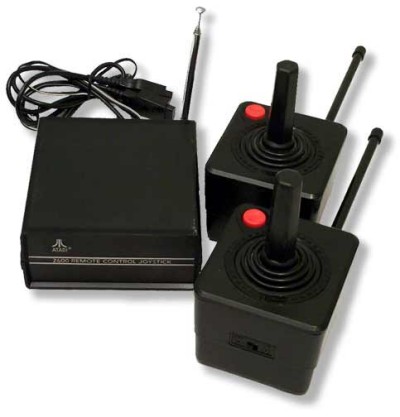 IR controllers controller also had their own deficiencies. The controllers required an uninterrupted line of sight between the controller and the machine. This meant that you would lose control if something/someone got between you and your console. It also meant that you had to point the controller directly at the sensor.
IR controllers carried on well on to be used in 2000, but the technology would fail to meet the requirements of newer consoles. Controllers began to feature more functions and capabilities and infrared could not handle higher data transfer requirements needed. Also infrared could only transfer data in one direction, so features such as force feedback (rumble) could not be reproduced.
Developers began to use the regulated frequency ranges of 902 to 928 MHz. These frequency ranges allowed a higher two-way data transfer that was omni-directional, meaning it didn’t have to be pointed at the sensor, and it had 4 or more available channels for multiple controller usage.
One of the first controllers to debut with this technology was a 3rd party controller (AirPlay) for the Sony Playstation.
Wireless Controllers –Advanced Models
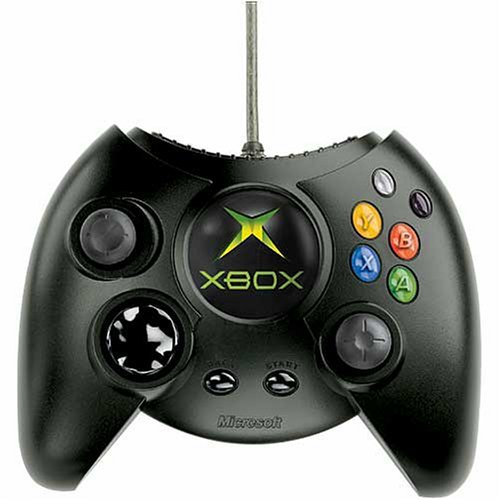
 The controller can work wirelessly up to 30ft and can run up to 40 hours on 2 ‘AA’ batteries but this of course leads to a lot of disposable batteries, so Microsoft realised a ‘charge & play’ pack separately which allowed for a rechargeable battery pack. The controller even works on Windows based PC gaming.
Microsoft had decided to stick with the Wi-Fi, but there console competition would use different technology.
Bluetooth is a wireless protocol utilizing short-range communications to transfer data over short distances from fixed or mobile devices. It uses 2.4 GHz frequencies just like Wi-Fi, but Bluetooth uses different modulation techniques. Bluetooth avoids other devices like cordless phones and Wi-Fi networks by dividing communications into 79 channels that change up to 1600 times per second. While Wi-Fi was primarily designed for wirelessly networking computers Bluetooth was designed to act like an invisible cable connecting devices. It can create wireless personal area networks (PANs) with one master device communicating with 7 other devices. It uses very little power and can easily connect other Bluetooth devices by ‘discovering’ them when they are near each other, so no configuration is needed.
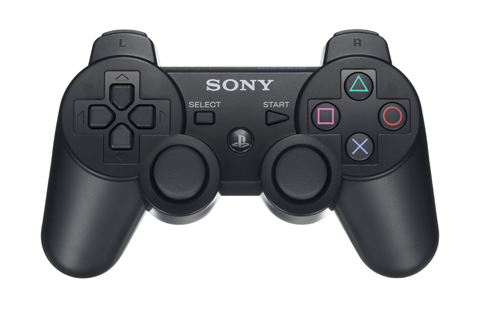
Sony later on realised the DualShock 3 controller this featured the SIXAXIS and brought back the Force Feedback. The controllers contain a gyroscopic sensor and an accelerometer that can translate yaw, pitch and roll into onscreen action.
Advanced Motion Gaming Controllers
Nintendo have upped the anti as far as controller innovation. Their efforts made motion controlled gaming mainstream. Their Wii console attracted previously untapped audience of casual gamers both the young and the old. It only made sense that the competition would want a piece of the action.
 Nintendo made motion gaming fun, but their Wii-Mote controller did not really translate 1:1 movement to onscreen game action. Literally, a flick of the wrist from your couch could score you a home run with the Wii Sports. While this works for lazy gamers, it did not represent true game immersion. Nintendo responded to this by releasing Wii MotionPlus in 2009. The Plus was a add-on which incorporated a dual-axis turning fork gyroscope and a single-axis gyroscope. In 2010 Nintendo released the Wii remote Plus, which basically just had the MotionPlus built into the controller.
 In 2010 Sony released the Playstation Move. Which is basically the Nintendo Wii and the Xbox Kinect put together. Sony basically took the technology of their Dual Shock 3 and moulded it into a wand controller. The Move controller looks like a microphone, also includes an additional magnetometer to determine the controllers orientation. The move is an impressive controller, however the Move was designed to work with the Eye. At the top of the Move controller is a orb that can glow in a wide range of colours. The Eye also recognizes the gamer and how the controller is in relation. The Move’s built-in sensors and the Eye’s recognition library give the controller high precision and movement accuracy in 3D space. For example the PS3 can determine the location of the controller even if hidden behind your back.
Microsoft wouldn’t be left out of the motion controller. In 2010 Microsoft released the Kinect for the 360. The Kinect sticks to it’s ad line ‘You are the controller.’ The Kinect is a camera interface very similar to the Playstation Eye but moved up a level. The Kinect features 3D motion capture, facial recognition and advanced gesture recognition. It has four microphone array that is capable of sound location tracking, echo cancellation, noise suppression and speech recognition.

The Move.me
The Move.me is something that Sony Playsatation is releasing to go with the Playstation Move.
The Move.me is not a game, instead it is an application that uses the Move motion controller as an input device. Sony want to see what applications programmers can create using the Move controllers on the Playstation system via the Eye camera and PC.
The Move.me is now available for download on the Playstation Network.
The Move.me has been designed for academic researchers, university students, college students, programming hobbyists and HCI developers.
Sony are interested in how areas beyond traditional gaming and have a list of areas that could be looked into.
- Games and tools that support children’s physical fitness/nutrition
- Child friendly programming interfaces for computer/technology classes or individual learning
- Physical therapy and rehabilitation
- Sports physiology or fitness training
- Music and creative arts
- Augmented reality, 3-D and other leading-edge technologies
- Addressing Physically-challenged or special education needs
To play the Move.me you will need to have;
- Playstation 3 system
- Move controller
- Playstation Eye camera
- PC or internet-connected device
After looking on the Forum’s on the Playstation website it does seem to have a few issues with coding and some people who want to learn about coding haven’t got much of a basic coding tutorial to read or learn about the code.
I personally didn’t know what to make of it. I mean I found it funny how you could pick up the controller and use it as a sword but other than that until someone creates something the Move.me might get overshot by the Kinnect.




No comments:
Post a Comment